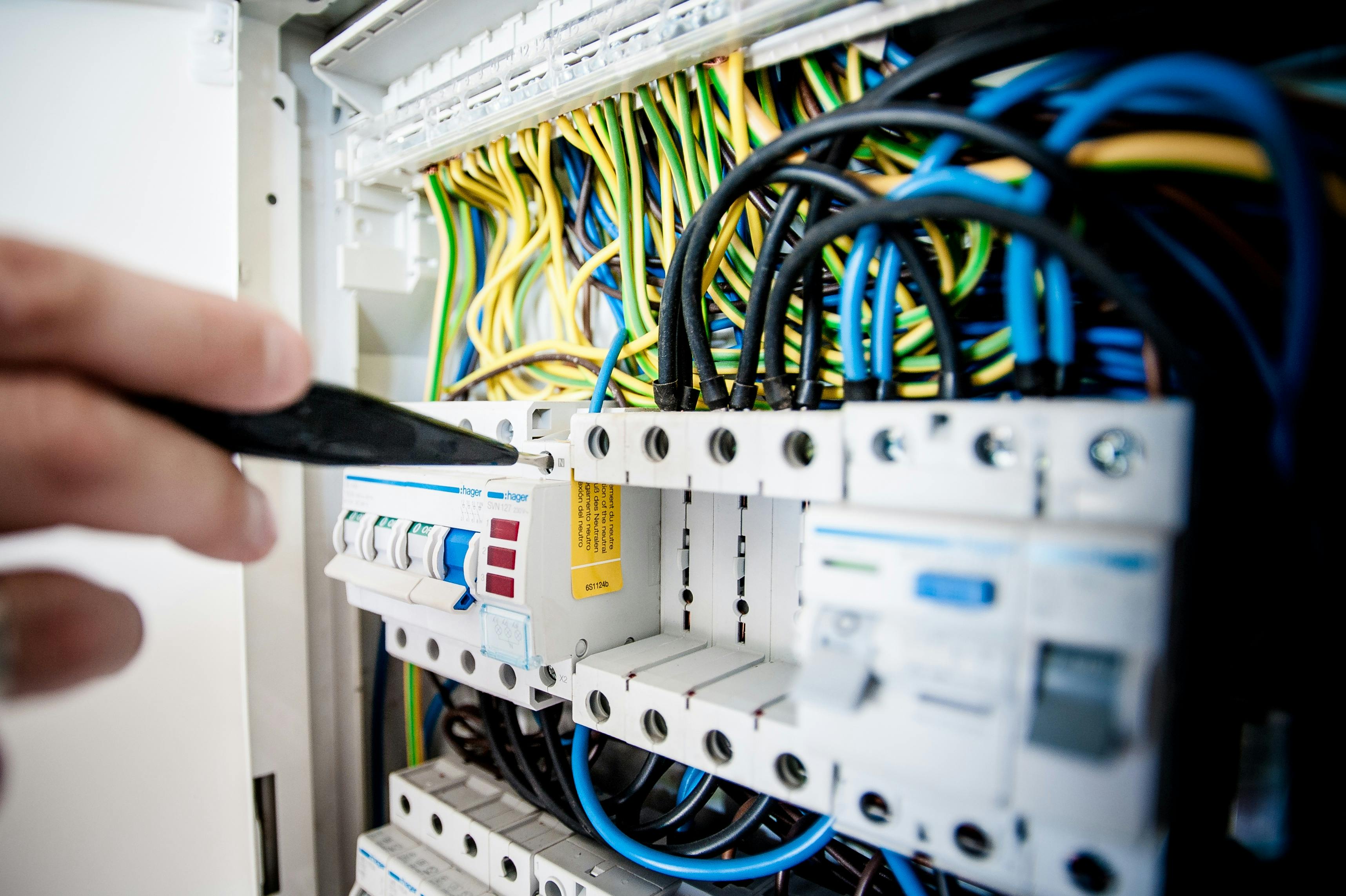
Most undersized enclosure cooling units were sized correctly. They were sized for the wrong temperature. A unit rated 1,500W at 35°C ambient delivers considerably less at 48°C — and 48°C is what the air beside a cabinet in Ahmedabad reads in May.
Cabinet, Enclosure, Panel — All the Same Product
The vocabulary in this category is inconsistent and it makes comparing options harder than it should be.
Enclosure air conditioner, control cabinet air conditioner, electrical cabinet air conditioner and panel air conditioner all describe one thing: a sealed refrigeration unit with two separate air circuits, fitted to an electrical enclosure, cooling the air inside without letting plant air in.
The terms diverge only in who uses them. OEMs and panel builders say cabinet or enclosure. Plant maintenance teams say panel. A specification written in one vocabulary is often quoted against in the other, which is worth knowing when you compare responses.
Calculating the Heat Load
Two terms, added together. Get both right and the sizing follows automatically.
1. Heat Generated Inside the Cabinet
Every component turns part of its rating into heat. Use published dissipation data where you have it. Where you do not, these working figures are reasonable starting points.
| Component | Heat Dissipated | Engineering Note |
|---|---|---|
| Variable frequency drive | 2 – 3% of rating | A 22 kW drive contributes roughly 440–660 W |
| Servo drive | 3 – 5% of rating | Higher than VFDs because of duty cycle dynamics |
| Transformer | 3 – 5% of VA rating | Continuous heat load, regardless of machine activity |
| Switch-mode power supply | 10 – 15% of output | Small alone, but material in a densely populated cabinet |
| Controller rack with I/O | 20 – 50 W typical | Check manufacturer figure for large distributed racks |
| Contactors and relays | 2 – 10 W each | Negligible individually, but adds up quickly across large panels |
2. Heat Crossing the Cabinet Walls
The cabinet exchanges heat with the plant around it. The formula is:
A is the effective external surface area — only faces exposed to air, so exclude any face mounted flush against a wall or another cabinet. ΔT is the gap between plant ambient and your target internal temperature. And k is the heat transfer coefficient: approximately 5.5 W/m²K for painted sheet steel, 3.7 W/m²K for stainless steel.
3. Add Margin, Then Check the Derated Figure
Add the two terms, then add 20–25% safety margin for estimation error, equipment added later, and gradual condenser fouling.
Then ask what the unit delivers at your design ambient rather than at its catalogue rating condition. This is the step most often skipped and the one that decides whether the installation survives May.
The Sign Trap — This Catches More Engineers Than Any Other Error
If plant ambient is ABOVE your target internal temperature, the wall term ADDS to your cooling load. If ambient is BELOW it, the cabinet sheds heat on its own and the term SUBTRACTS. A cabinet sized correctly during a mild month can be badly undersized in summer purely because this term changed sign. The equipment inside did not change at all.
Design Ambient Temperature by Indian City
This is the number that decides whether your cooling works in the month you need it most.
These are outdoor design figures. The air beside a cabinet on a shop floor typically runs 3–8°C hotter, and considerably more near a furnace or on a rooftop. Measure beside your own cabinet before you commit.
| City / Region | Summer Design Ambient | Humidity | What Governs the Specification |
|---|---|---|---|
| Delhi NCR — Gurugram, Manesar, Noida | 45 – 47°C | Low | Rated ambient. A 43°C-rated unit will not hold setpoint. |
| Rajasthan — Bhilwara, Alwar, Neemrana | 45 – 47°C | Very low | Filter design — extreme dry heat plus heavy dust |
| Nagpur, Raipur, central belt | 44 – 46°C | Low | Rated ambient. Steel and power sector thermal loads. |
| Ahmedabad, Sanand, Vadodara | 42 – 45°C | Low–moderate | Rated ambient, sustained heat from April to June |
| Ludhiana, Faridabad, Chandigarh | 42 – 44°C | Moderate | Wide seasonal swing — risk of short-cycling in winter |
| Hyderabad | 40 – 43°C | Moderate | Validation and strict documentation in pharma clean zones |
| Vapi, Ankleshwar, Surat | 38 – 41°C | High | Corrosion resistance and chemical atmospheric sealing |
| Pune, Chakan, Nashik | 38 – 40°C | Moderate | Internal heat load dominates over external ambient |
| Chennai, Sriperumbudur | 38 – 40°C | Very high | Condensate volume and specialized drain design |
| Coimbatore | 37 – 40°C | Moderate–high | Foundry sand and textile fly dust protection |
| Mumbai, Navi Mumbai, Thane | 35 – 38°C | Very high | Sustained humidity year-round and condensation management |
| Bangalore — Peenya, Bommasandra | 35 – 37°C | Moderate | Mildest cluster — but internal heat load calculation still applies |
IP Ratings — What You Actually Need
The IP code has two digits: the first for solids, the second for liquids. Higher is not automatically better. Beyond what your environment requires, it buys nothing.
IP54 is the sensible default for indoor industrial use. IP55 earns its place in washdown-adjacent areas and high humidity. IP65 matters for food and pharma washdown or genuine outdoor exposure.
The Question Almost Nobody Asks: Does the stated IP rating apply to the assembled cabinet with the cooling unit fitted, or only to the empty enclosure before someone cut an aperture into it? Cutting for a cooling unit compromises the rating unless the unit and its gasket are rated to match. Ask for the rating of the assembly, in writing.
Condensation — Where the Water Goes
Cooling air below its dew point produces water. That is physics, not a fault, and a cabinet in Chennai produces considerably more of it than the same cabinet in Jaipur.
What matters is where it goes. A properly designed installation collects condensate and routes it out through a drain that is correctly sized, correctly sloped and unobstructed.
- Verify drain routing at commissioning, not at the first monsoon
- Check the outlet is not pointing at another piece of electrical equipment
- In humid coastal regions, plan for continuous gravity drainage rather than occasional collection
- Do not set internal temperature lower than the equipment needs — every unnecessary degree makes more water
- A cabinet idle in a humid region can sweat when switched off; consider an anti-condensation heater
- Check the drain at every service visit — a blocked drain is the commonest cause of water inside a well-specified enclosure
Conclusion
Enclosure cooling is arithmetic, not judgement. Internal heat load plus the wall term, margin added, then derated to your real ambient. Four numbers and the answer follows.
The failures happen when one of those four is assumed rather than measured — usually the ambient, and usually because the measurement was taken in a mild month.
Measure beside your cabinet on the hottest afternoon you can find, and specify against that figure. Everything else in this article is straightforward once that number is honest. Learn more on our Haima homepage about industrial enclosure cooling engineering.
Have Your Heat Load Calculation Verified
Rather than running the calculation twice, send us the inputs and our engineers will confirm the capacity you need at your design ambient — not at a catalogue rating condition.
- Cabinet dimensions and material
- Everything inside it, with ratings
- Ambient measured beside the cabinet on a hot afternoon
- Your target internal temperature
- Whether the area is ever washed down